What to See on Phnom Kulen:
A Complete Guide
Phnom Kulen National Park isn’t one site, it’s a forested plateau scattered with waterfalls, river carvings, hermit caves, and the buried remains of a 9th-century capital. Most day-trippers see three stops and leave. Here’s the fuller picture, organized by how much time and effort each one takes.
Orientation: how the plateau is laid out
Phnom Kulen sits about 40–50 km northeast of Siem Reap, roughly a 1–1.5 hour drive. A single paved road connects the park’s most visited sites – Preah Ang Thom and the main waterfall – which is why nearly all tour buses stop at exactly those two places and nowhere else. The rest of the plateau, including the villages of Popel and Anlong Thom and the forest around them, only got road access after 2017, and parts of it are still best reached on foot or by moto with a local guide.
That’s the practical reason most “what to see” lists are so short: most visitors physically can’t get past the first two stops without a guide who knows the trails.
The essentials (what nearly every visitor sees)
Preah Ang Thom and the reclining Buddha
A 9th-century reclining Buddha carved directly into a sandstone boulder at the plateau’s summit, inside an active pagoda. This is Phnom Kulen’s most visited site and the busiest, but it’s genuinely worth the crowd, the Buddha is carved from the living rock, not built on top of it.
The River of a Thousand Lingas (Kbal Spean)
A riverbed carved with hundreds of lingas – cylindrical stone symbols – along with images of Vishnu and other Hindu deities, cut directly into the sandstone under flowing water. Ancient Khmers believed water flowing over these carvings sanctified everything downstream, all the way to Angkor’s rice fields. It’s a short walk from the road and rarely takes more than 20–30 minutes.
Phnom Kulen Waterfall
The plateau’s main waterfall, and the site most tour itineraries build their schedule around. It’s beautiful, swimmable in the right season, and – because it’s the easiest stop to reach – also the most crowded, especially around midday and on weekends.
Beyond the main road: what most visitors miss
The hermit caves and hidden carvings of Anlong Thom
The Anlong Thom area holds one of the densest concentrations of archaeological sites on the mountain — ancient hermit rock shelters, carvings, and long-overgrown temple foundations reachable only by trail or a short motorbike ride with a local guide. This is the closest most visitors will get to seeing Mahendraparvata’s scattered remains up close, rather than reading about them on a signboard.
Popel’s forest and waterfalls
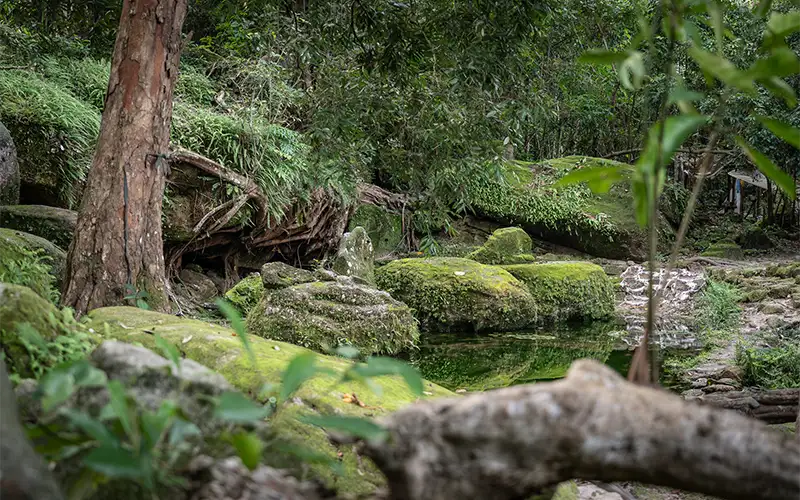
Popel protects the largest remaining forest cover on the plateau — dense canopy, boulders, streams, and waterfalls well off the paved road. It’s the place to go if what you actually want from Phnom Kulen is the forest itself, not just the ruins inside it.
Mahendraparvata, the buried capital
Most of Jayavarman II’s 9th-century capital is still under jungle canopy, mapped in detail only since a 2012–2013 airborne LiDAR survey revealed a grid of roads, reservoirs, and temple mounds beneath the forest floor. You won’t see a restored complex here – most of it isn’t excavated – but knowing it’s there changes how you look at the plateau. This isn’t scenery. It’s a city.
Budget for going beyond the main road: a full day, and ideally a guide from one of the plateau’s community-run trekking centers, since these areas aren’t signposted for independent visitors.
Practical notes before you go
- Entrance fee: There’s a national park entrance fee separate from any trekking or guide fees: budget for both.
- What to wear: Preah Ang Thom is an active pagoda; cover shoulders and knees. For the forest treks, closed shoes are worth it over sandals.
- Best time of year: Waterfalls are fullest in and just after the wet season (roughly June-October); trails are easier to walk in the dry season. More on timing in a separate post.
- How much time to give it: A half-day covers the essentials. A full day gets you into the forest and the less-visited archaeological sites, or the hidden spots in the forest.
The short version
If you have half a day: Preah Ang Thom, the River of a Thousand Lingas, and the main waterfall. If you have a full day or two: add a guided trek through Popel or/and Anlong Thom, where the forest, the hermit caves, and the quieter side of the mountain’s history are waiting past the point where most tour buses turn around.